Tuesday, December 11, 2012

BEIJING - NOVEMBER, 2012 [PART TWO]

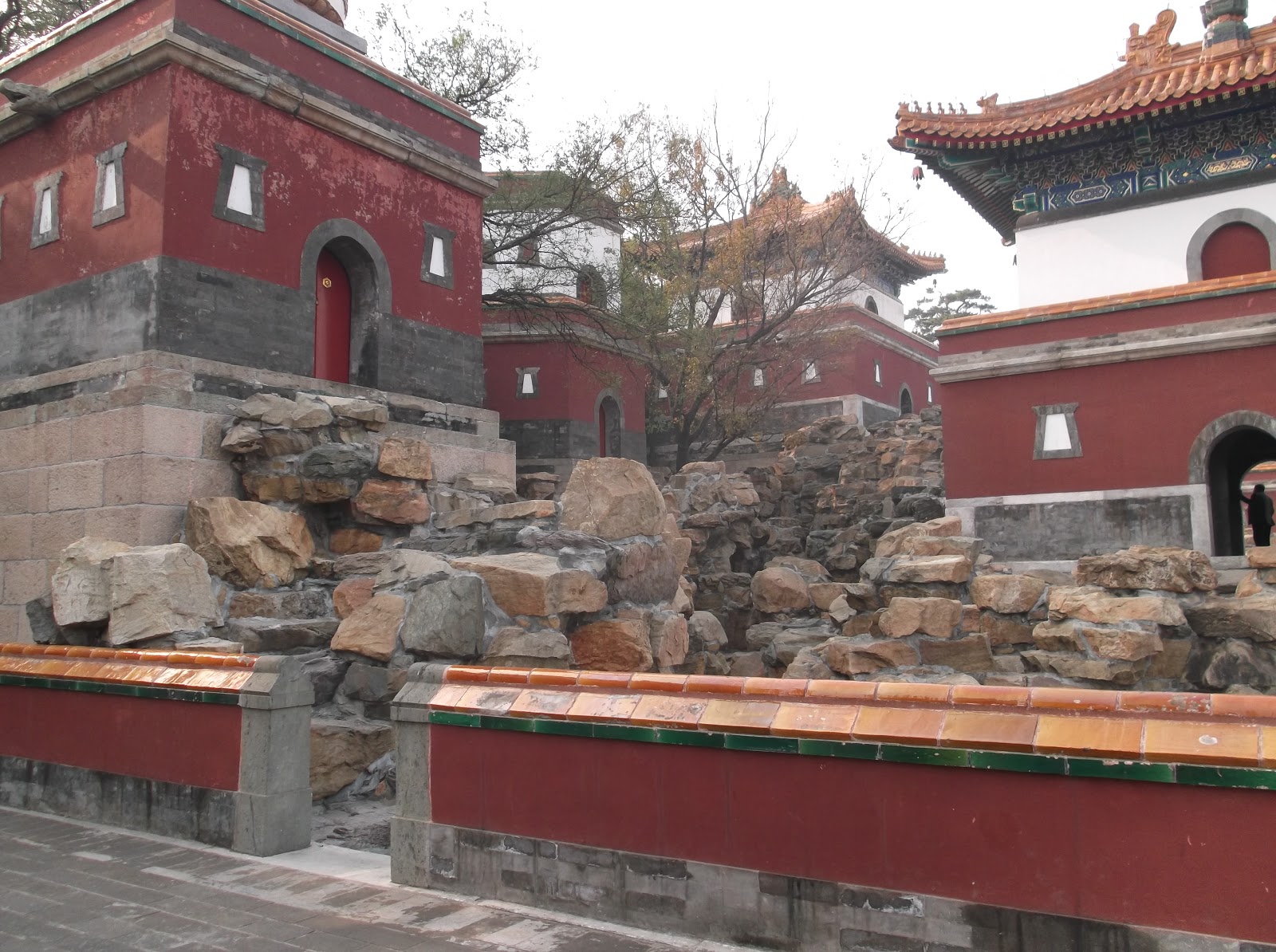
On my second day in Beijing I travelled to the Summer Palace which is about 7 1/2 miles north of central Beijing. This large garden and lake complex dates back eight centuries when it was built as an imperial retreat from the summer heat of Beijing. It was ransacked by British and French soldiers in 1860, and burned by Western soldiers in 1900 seeking revenge for the Boxer Rebellion. It is a huge park with pagodas, palaces, lakes, and forests. Most of the 700 acre park is taken up by Kunming Lake, which is largely man made. The dirt from the excavation of the lake was used to build Longevity Hill, upon which the main Summer Palace buildings are built.


As you enter the palace grounds on the north side, through the entry gate, you climb up the north side of Longevity Hill which contains the main buildings of the Summer Palace complex. As you reach the top of the hill you look out over Kunming Lake, and then walk down to the lakeshore.


When you reach the lakeshore you exit through the south gate of the temple complex. There are walkways, bridges, canals, and dikes to walk along with a view of the lake and of the temple complex on Longevity Hill. There are boats that you can take to ride about the lake, and out to South Island in the lake. There are also places to eat along the lake. It must be very beautiful in the summer when the weather is warm (but the crowds are large.)


I took a boat ride out to South Island which is connected to the shoreline by a causeway, then walked back to the main palace complex before leaving the park to return to Beijing. I have also included a professional photo which gives a clearer view of the complex on Longevity Hill. My day at the Summer Palace was long and strenuous, but filled with many memories.

BEIJING - NOVEMBER, 2012 [PART ONE]

This was my second trip to Beijing, China. I spent several days in Beijing in 2008 when I traveled throughout China for several weeks with Michael. We saw most of the important tourist sights in Beijing, but I always wanted to return to see the spots that we missed, and to revisit some of the places we saw, and spend more time there. Because this was the off-season, the sights were less crowded, and because I was on my own, and not part of a tour group, I could spend as much time at each location as I wanted.


On my first day I visited the Lama Temple (Yonghegong), which means the "Palace of Peace and Harmony." The Lama Temple is Beijing's most visited religious site, and one of the most important functioning Buddhist temples in Beijing. The temple was actually a number of buildings with courtyards, each containing Buddhist relics, art, and figures. There were few people there the morning that I went, so walking throughout the grounds was very peaceful.


From the Lama Temple I walked a short distance through one of the local hutongs to the Confucious Temple (Kong Miao), which is China's second largest Confucious temple. Although there were few people there the morning that I went, the temple is the busiest before national university entrance examinations, when students and parents descend in droves to seek out the Great Sage's assistance.


Next I traveled to the Temple of Heaven Park (Tiantan Gongyuan) which is a large park south of the Forbidden City. This was the site where emperors once performed important rites. The most prominent building is the Temple of Heaven, which is round on top (representing heaven) and square on the bottom (representing the earth). Each year the emperor would come to this temple to offer sacrifices, meant to please the gods so that they would provide generous harvests. Now, early in the morning you find parkgoers performing tai chi, kung fu, group dancing, or playing games and cards. I also saw several new brides and grooms getting their wedding photos taken.


Tuesday, December 4, 2012

TOKYO - OCTOBER, 2012 [PART THREE]

On the last Sunday I was in Tokyo I took a day trip with my friend Chikako, an english speaking guide that I met last year in Tokyo, to an island off the coast of Japan about 1 1/2 hours by train from Tokyo. The island is called Enoshima, and is close to an area called Kamakura that I visited last year.


Enoshima is about 600 meters off the coast, and is connected to the coast by a causeway. On the island is a small village area with shops and places to eat. A tall observation tower is at the top of the island, which affords views of the surrounding coastline area. There are also several shrines on the island, and a tunnel complex on the opposite side of the island from the view shown above.


When you first cross onto the island you walk uphill through a small village area with shops and places to get food. A lot of the Japanese tourists were buying a snack to eat which was in large sheets that looked like candy. I asked Chikako what the food was and she said it was octopus!!! I had her ask one of the ladies eating it if I could take her picture with the snack, and she offered me a piece to eat. It tasted like salty cardboard.


On the island there were numerous religious shrines and Japanese gardens.


At the top of the hill on the island there were numerous observation areas with a view of the coastline, and a tall observation tower with 360 dgree views of the coastline and the back side of the island.


These photos show views from the top of the observation tower over the backside of the island. The buildings in the middle photo are restaurants with a view out over the ocean.


From the top of the hill you could follow steps and a trail down to the coastline on the back side of the island, then follow a walkway around the coastline to a series of ocean caves. It was low tide at the time of these pictures, with numerous tide pools exposed.


A view inside the caves, and looking out of the mouth of the caves to the coastline. I had a great time on this visit to Japan, and I hope that I can return again soon in the future to see more of that beautiful country.