Saturday, April 26, 2014

CAIRO - FEBRUARY, 2014 - PART 1

This was my first trip to Egypt. After flying from Los Angeles to Istanbul, Turkey, where I spent the night, I flew into Cairo. Because of the political turmoil that was taking place in Egypt with the overthrow of the government and violent protests, the tourism industry in Egypt was almost non-existent. On my flight from Istanbul I was the only westerner, and except for a group of about 15 Chinese tourists, the only tourist. The remaining passengers that I spoke with were businesspeople who were flying to Cairo for the day, then returning on an afternoon or evening flight. After picking up my baggage and clearing immigration and customs I entered the arrivals hall, and was the only arriving passenger there. Needless to say, I was a very popular target for taxi drivers and tour group salesmen.

I spent three days touring the historical and tourism sites in and around Cairo. I had arranged for a private driver and tour guide which was essential because of the distances between tourist sites, the lack of public transportation, the never ending traffic congestion, and the threat of political unrest and violence. My guide for the three days was Amany Salem, who was excellent, and who provided me with not only a tour guides perspective to the tour sights, but also a perspective on Egyptian life and the current political situation in Egypt.

On my first day of sightseeing we began the day at the ancient capital of Egypt for a period of three thousand years, Memphis. Not much remains of the city itself, but a small museum with a stone statue of Ramses II and a small Sphinx. I did enjoy the drive there as we drove through a more rural area outside of metropolitan Cairo, so I had a good chance to view what life is like for many Egyptians today outside of the major cities.


From Memphis we drove to the pyramids at Saqqara. Here are located the step pyramids of Zoser [Djoser]. The step pyramid of Djoser, located in the center of the funerary complex of Saqqara, is the oldest structure in the world entirely built of stone. Besides the largest step pyramid of Djoser, there were several smaller pyramids, and tombs of various pharaohs and noblemen. We were the only tourists there, and I had the run of the place to myself. Being out in the desert, without crowds, the silence was deafening!


This is the entrance to an underground tomb. For a small price the guard unlocked the security door and I followed him down into the tomb through a small tunnel. The tunnel was only about five feet high, so I had to duck-walk several hundred feet down into the tomb and then back up. I could tell how out of shape I was because my thighs hurt for days afterwards.


From Saqqara we drove into the suburbs of Cairo where we had lunch at a local Egyptian restaurant. Walking into the restaurant we passed the entrance where chickens were being grilled, and flatbread was being baked. The food was delicious. Also, a picture of one of the busboys at the restaurant.


After lunch we traveled on to the pyramids at Giza. These are the largest pyramids, and generally the pyramids that we see in pictures. Although this was the height of the tourist season, when normally thousands of tourists would be crowding the entire pyramid area, there were only local Egyptian tourists and their families. I was the only western tourist there that I saw. These are pictures of the pyramids and the surrounding area.


These are pictures taken from the base of the pyramid of the area surrounding the pyramids, where you could ride horses or camels. The suburbs of Cairo are expanding right up to the edge of the plateau where the pyramids are located.


Adjacent to the pyramids at Giza is the Sphinx, which was the first colossal statue constructed in ancient Egypt.


These are pictures of the street scene in Giza, just outside the entryway to the Sphinx.


After visiting the pyramids my driver returned me to my hotel in the eastern suburb of Heliopolis which took about one hour. We crossed the Nile River, and you can see the mix of the old, more rural, and the newer, more modern areas of Cairo.




Thursday, March 6, 2014

THAILAND - JANUARY, 2014

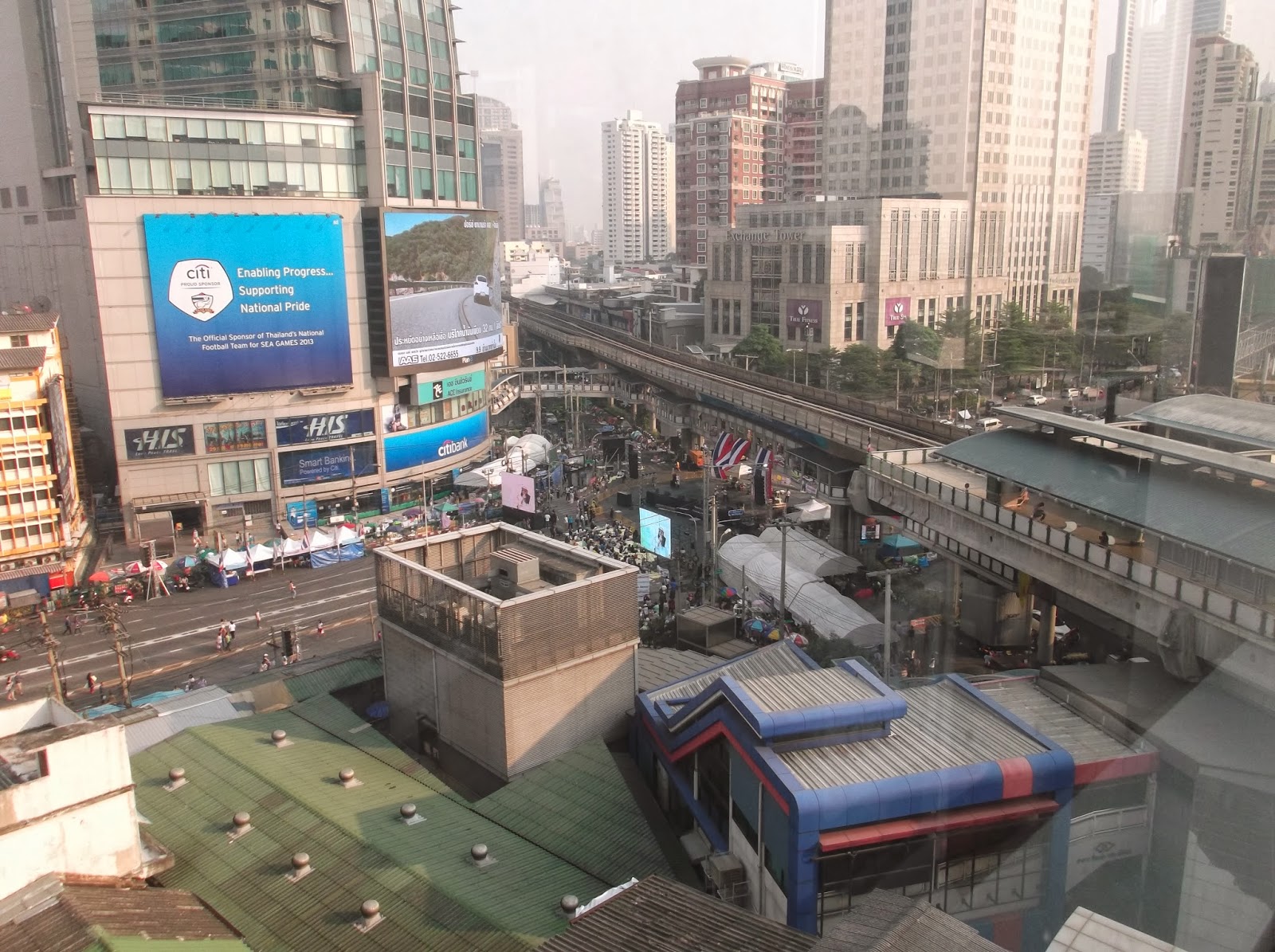
After spending the night in Singapore, having flown from Los Angeles via Tokyo; I flew on to Bangkok, Thailand which I had previously visited in 2006. At the time of this visit there were major anti- government protests taking place in Bangkok, with the protesters vowing to shut the city down. The protesters had occupied over a dozen of the major intersections in the city which made travel by street very difficult, and hampered visiting various areas of the city. The night I arrived in the city the main intersection by my hotel, near the Asoke metro station, was filled with several thousand protesters, which made reaching my hotel very difficult. This is a view of the intersection several days later from the window of a restaurant where I was eating. Later that night the intersection and surrounding streets again filled with several thousand protesters.


My hotel was located about one block from the main intersection up a small side street [Soi 18] which had a more small town feel than the main, and normally busy main streets in the area.


Because many of the areas of the city were not accessible because of the protesters closing many of the main roadways, I took the Skytrain across town to the Chao Phraya River where I boarded a water taxi to travel up river to the Grand Palace complex. The Chao Phraya River is the largest river in Thailand, and serves as a means of transporting goods and products from the interior of Thailand out to the ocean. While traveling up the river I saw many barges filled with rice and other agricultural goods navigating the river. Entire families live on the barges [in the upper area of the rear of the barge], and you could see the families cooking food and washing clothes on the barges as they passed by.


While going upriver we passed Wat Arun one of the most famous landmarks in Bangkok. I had visited the wat previously, so I didn't stop again on this trip.


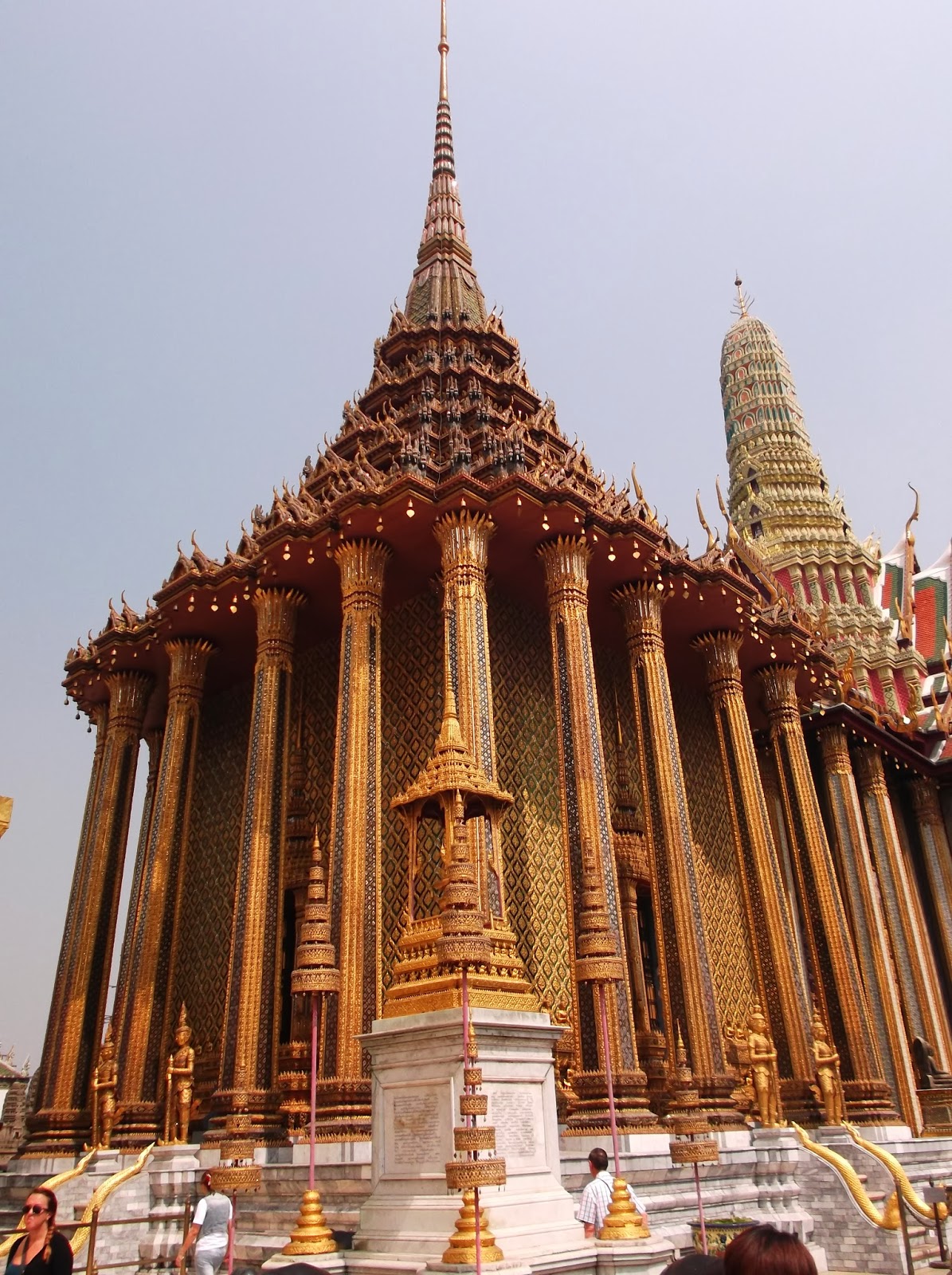
The Grand Palace, which lies behind massive white battlements, is the most stunning of all the sights in Bangkok. Built by successive monarchs over a period of more than 200 years, the grounds contain many palaces and building reflecting the varied tastes of the numerous kings who built them. This is the Grand Palace, which used to serve as the royal residence of the king, and is still used for the most important ceremonial occasions of the royal family, and other buildings in the immediate area of the Grand Palace.


In the area surrounding the Grand Palace, inside the walls of the Grand Palace grounds, are many of the most beautiful historical buildings in Bangkok. These are some random pictures of the buildings in that area.


The most stunning temple on the grounds houses the Emerald Buddha which is carved from a single block of jade. Unfortunately, photos are not allowed inside the temple housing the Emerald Buddha.


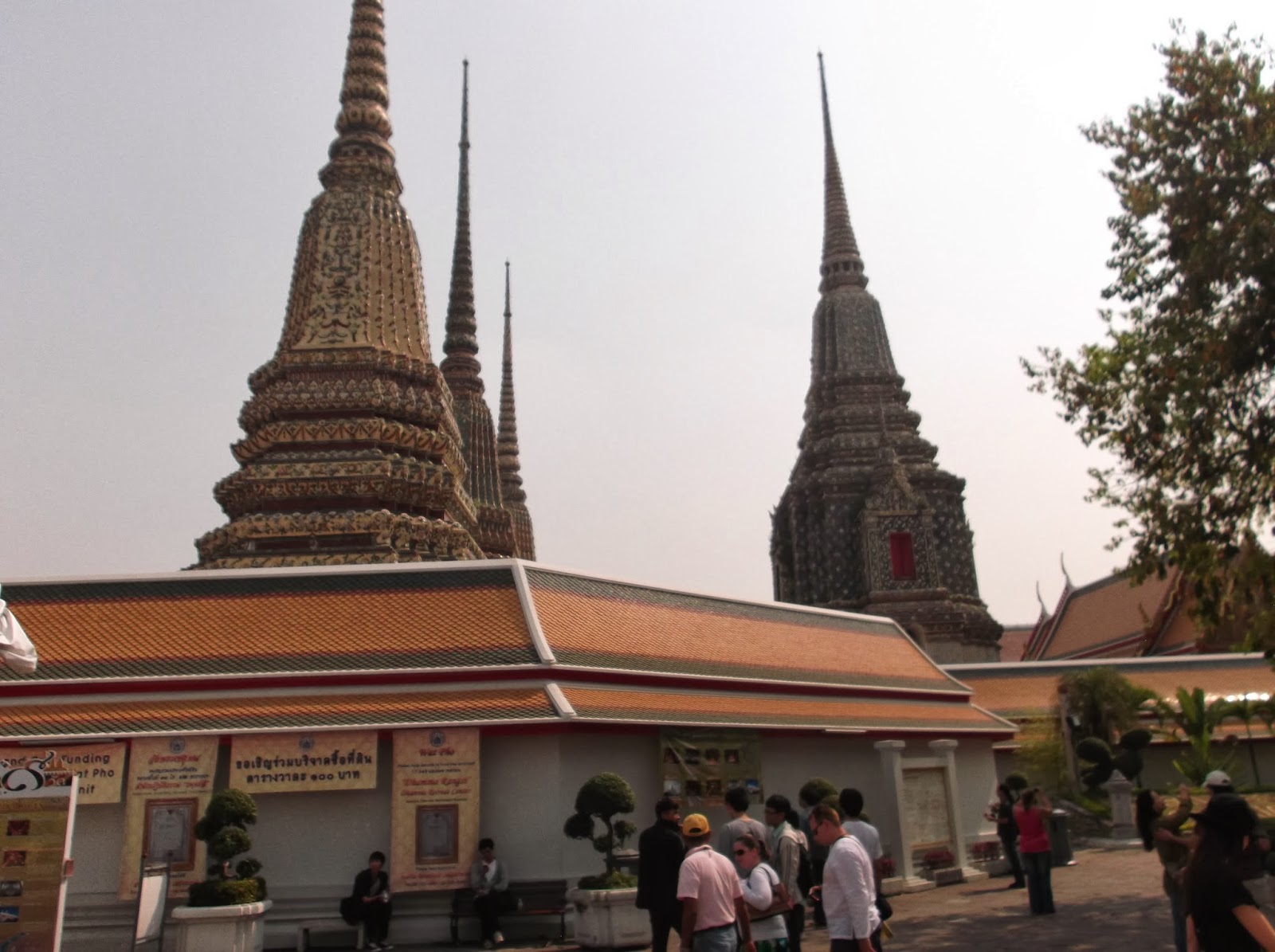
A short walk from the Grand Palace compound lies Wat Pho where the largest reclining Buddha in the world is located, as well as the largest collection of  Buddha images in Thailand. These are some pictures of the temple grounds, and of the Reclining Buddha.


From Bangkok I took a short flight to Chiang Mai, Thailand's second largest city, located in the northern part of Thailand. Compared to the big city hustle and bustle, and noise of Bangkok, Chiang Mai was smaller, slower paced, and relaxing. I stayed in a small boutique hotel called the Rim Resort, located within the partially walled, and moat surrounded Old City part of Chiang Mai. These are photos of the moat in front of the entry to the resort, the entrance to the resort, a picture of the inside of my room, and pictures from my balcony to the pool area of the hotel.


The most visited sight in Chiang Mai is the Wat Phra Singh temple which houses the city's most revered Buddha image.


The oldest wat in the city is the Wat Chiang Man established when the city was founded in 1296. It features typical northern Thai architecture.


Crossing the moat bordering the northern side of the Old City I visited the Wat Lok Molee which also had the very interesting architecture of northern Thailand.


While walking around the Old City I came across two sister missionaries. I walked with them to the local chapel where they met some of the elders to head off for their p-day. I think they enjoyed seeing and talking with someone from home.


I really enjoyed my trip to Thailand, and I look forward to returning someday to spend more time visiting the country and enjoying the friendliness of the Thai people.